Kalmar and Elonroad integrate conductive charging rails so reach stackers, terminal tractors and yard vehicles charge automatically while driving, queuing or parked. This makes charging part of the operation; cutting downtime, reducing the need for cable-chargers and minimizing battery size.
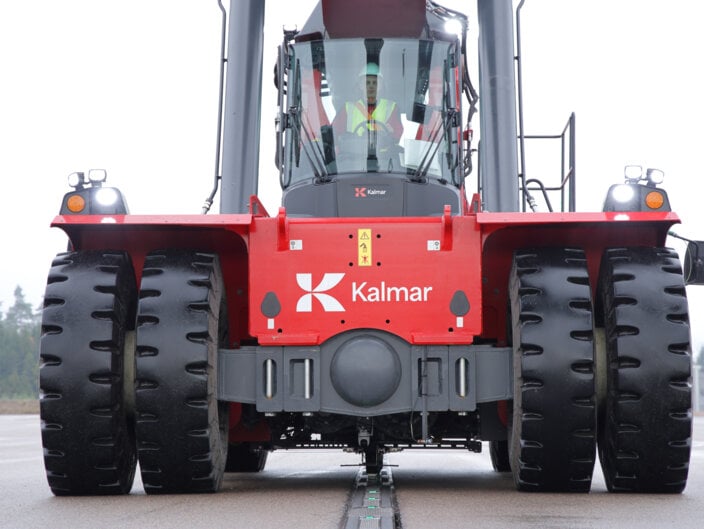
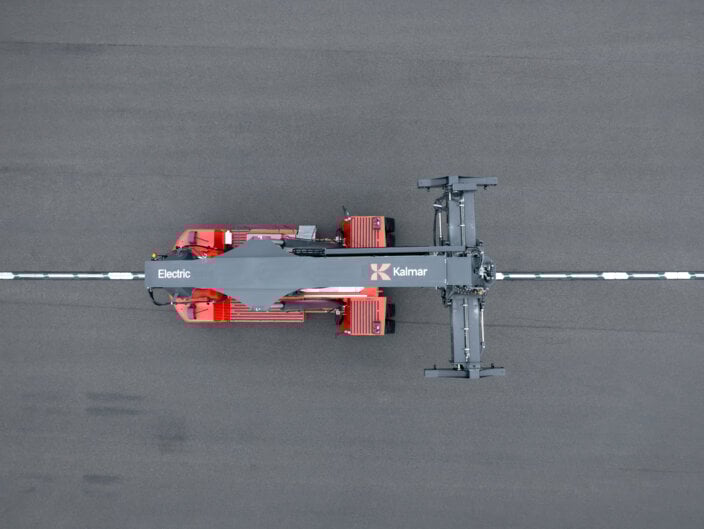
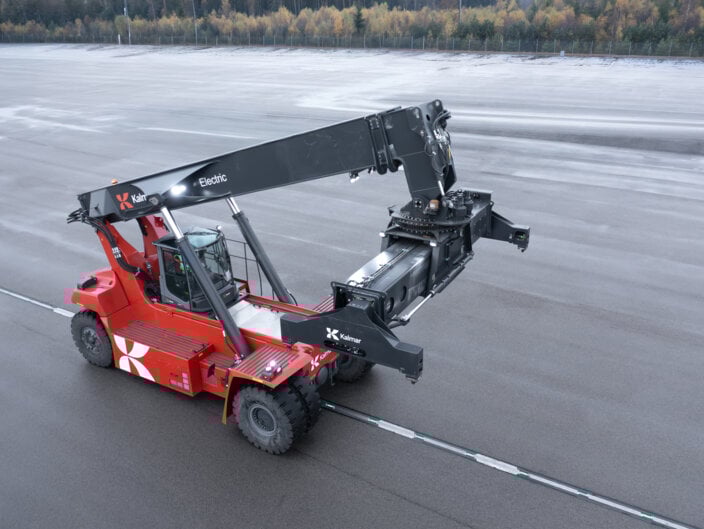
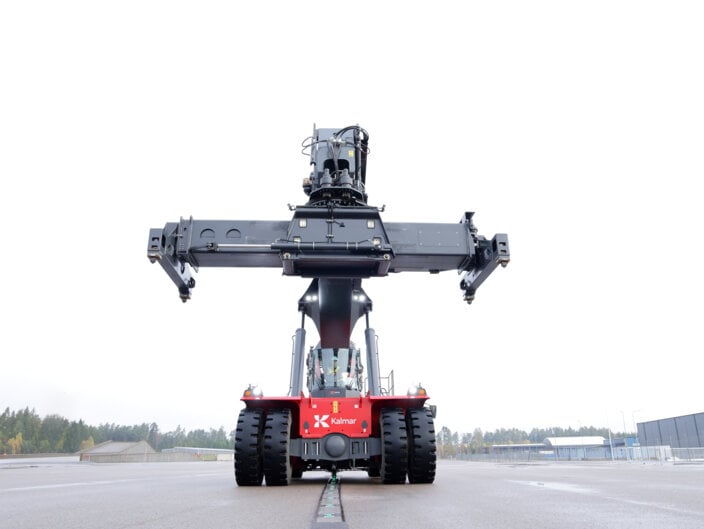
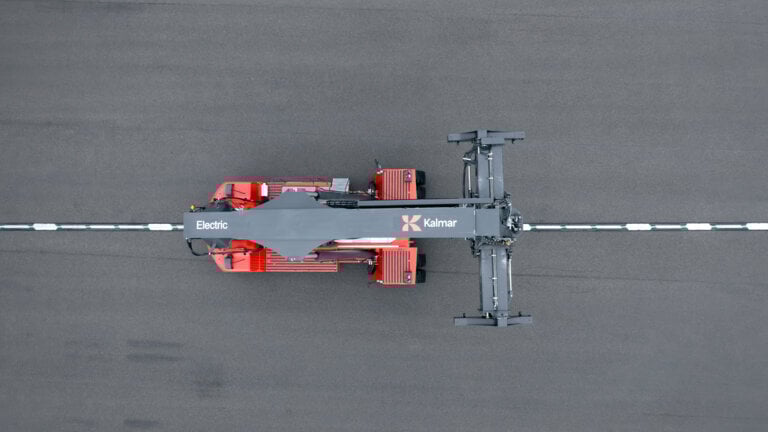
At the Kalmar Innovation Center test track in Ljungby, an electric Kalmar Reachstacker and Terminal Tractor is currently being demonstrated together with Elonroad’s conductive charging rail. The machines receive power directly from the rail without cables or manual connection.
This demonstration shows how charging can be integrated directly into terminal infrastructure, allowing energy to be supplied where machines already drive or stop. The goal is to explore how this type of charging infrastructure could support multiple types of Kalmar heavy vehicles operating in ports, terminals and logistics hubs.
Continuous charging for high-intensity terminal operations
Port and terminal environments are characterised by high equipment utilisation and continuous movement of goods. Reachstackers, terminal tractors and other yard equipment often operate across long shifts with minimal downtime.
Traditional charging approaches require machines to stop and connect to stationary chargers. This can introduce operational bottlenecks, require additional backup vehicles and occupy valuable terminal space.
Elonroad’s conductive charging technology enables charging to be integrated directly into the ground surface in selected operational areas.
Charging can occur automatically while vehicles:
- drive along defined routes
- queue or wait during operations
- park in designated charging zones
Charging becomes part of the operation rather than a separate process.
What the system delivers today
Charging becomes part of the operation, not a separate process.
|
The Elonroad charging infrastructure is designed for high-utilisation industrial environments and delivers:
|
For terminal operators Elonroad enables:
|
Two complementary charging solutions
Elonroad’s technology can support electrified terminal operations through two complementary charging approaches:
Stationary Charging (Charge Station)
Automatic conductive charging while vehicles are parked over the rail.
Typical locations include:
- Loading areas
- Parking zones
- Holding zones
This enables vehicles to charge during natural pauses in operations without driver intervention.
Dynamic Charging (Closed-Loop Charging)
Conductive charging while vehicles drive along defined terminal routes.
Typical applications include:
- Container terminals
- Port yards
- Logistics hubs
- Industrial sites with predictable vehicle routes
This approach allows machines to receive energy continuously while operating, reducing reliance on large onboard batteries. The rails are divided into short segments and are only energised when an authorised vehicle is positioned directly above the rail.
The two solutions can be deployed in phases, aligned with your electrification roadmap.
Integrated digital management
Elonroad’s digital platform will provide the following to Kalmar Insight:
- Real-time monitoring
- Infrastructure diagnostics
- ESG reporting data
The solution supports future automation and autonomous-ready operations; aligning with Kalmar’s long-term automation roadmap.
Built with safety at its core
Safety is a fundamental part of Elonroad’s conductive charging technology, both for dynamic and stationary applications.
For dynamic charging, the system is designed with short one metre segments that are only energised when an authorised vehicle is positioned directly above them. This ensures that no active segment is exposed, eliminating the risk of accidental contact. The surface is also engineered to provide sufficient friction, ensuring safe driving conditions for all types of vehicles.
For stationary charging, additional protective measures are in place. When a vehicle is charging, safety curtains automatically enclose the conductive interface. This ensures that no live components are accessible during operation.
The result is a solution designed to be safe for operators and personnel, while maintaining reliable performance in demanding terminal environments.
The impact of automatic conductive charging on terminal economics
Elonroad is designed to help terminal operators lower the Total Cost of Ownership of electrified equipment by integrating charging directly into terminal operations. By supplying energy where machines already drive, queue, or park, the solution can reduce the need for large onboard batteries and minimize investment in extensive stationary charging infrastructure. This is important for terminal fleets to deliver both environmental and financial value.
This enables operators to electrify fleets while maintaining equipment productivity and managing energy demand more efficiently. The result is a pathway to electrification that supports both operational performance and long-term fleet economics.
The future of electrified terminals
The ongoing collaboration between Kalmar and Elonroad explores how integrated charging infrastructure could support electrification across an entire terminal ecosystem. Elonroad’s charging infrastructure could be deployed across:
- Container terminals
- RoRo and general cargo ports
- Intermodal terminals
- Distribution centers and logistics hubs
- Automated and semi-automated terminals
- Closed-loop industrial sites
Installation can be adapted to the terminal layout and electrification strategy. Rails can be integrated into or mounted onto the driving surface in the selected areas, without major reconstruction. This allows energy to be supplied where machines already operate, without overhead structures, cables or standalone charging cabinets in operational areas.
Adaptability for multiple Kalmar vehicle types
While the current demonstration focuses on the Kalmar Electric Reachstacker and Terminal Tractor, the vision for the future is that the technology should be adapted to a wide range of Kalmar heavy vehicles.
Applications could include:
- Straddle carriers (future integration potential)
- Other heavy-duty yard vehicles
- Light commercial vehicles operating within the terminal
A new approach to terminal electrification
Through Kalmar’s global sales and service network and Elonroad’s charging technology, the two companies are exploring how integrated charging infrastructure could support the next generation of electrified terminal operations.
Could this be part of the future energy system in your terminal?
Ressources
Frequently Asked Questions
How is dynamic conductive charging different from stationary charging?
Dynamic charging supplies energy while vehicles drive along defined routes; stationary charging supplies energy when parked on dedicated parking space equipped with charging rails.
Which vehicles are supported today?
The current demo features the Kalmar electric reachstacker and terminal tractor. The roadmap targets empty container handlers, forklifts, yard vehicles, and future integration for straddle carriers.
Is the rail energised when people are nearby?
No. Rails are segmented and de‑energised by default, activating only when an authorised vehicle is positioned above the segment.
What’s the impact on battery size and charging infrastructure?
By supplying energy where machines already drive, queue or park, terminals can reduce reliance on large onboard batteries and optimise the number/size of stationary chargers.
How is performance monitored?
Telemetrics is collected through both Elonroads cloud services and Kalmar Insight, providing real‑time status, diagnostics and ESG reporting data.